Follow an orchid’s journey.
The journey from the Americas to the Indian Ocean
Although associated with Madagascar, vanilla comes from tropical America.
Vanilla is the fruit of a climbing orchid. Native to tropical America, it took root in Madagascar thanks to the climate, plant exchanges across the Indian Ocean and the work of growers and curers. Four complementary distinctions help explain it: botanical species, geographical origin, curing and commercial grading. [3][5][10]
Follow the journey of plants and techniques to Madagascar.
The stages of this journey
- Before the 16th century
Mesoamerican knowledge
Read this episode
Mesoamerican peoples knew vanilla long before it spread to Europe. The Totonacs used it, and the Aztecs later combined it with cacao drinks, among other uses. Madagascar’s vanilla history thus continues a much older American history. [1]
- 1819–1822
Introductions to Bourbon Island
- 1841
Edmond Albius’s technique
Read this episode
- 19th century
Gradual establishment in Madagascar
Read this episode
The introductions and first plantations did not happen all at once. Historian Éric Jennings distinguishes Sainte-Marie, Nosy Be and then the main island; Bouriquet dates the spread from Réunion to around 1870. In the second half of the century, plants and techniques circulated, and cultivation gradually extended across the north-east. [6][5]
- 20th century
A leading Malagasy industry
Read this episode
Cultivation grew into a major commercial activity around Antalaha and in what is now the SAVA region. Madagascar became a key centre of world production. After independence, vanilla remained an issue of national economic importance: producer organisation, quality, markets and competition from industrial vanillin were central concerns. [8][6]
Why are there several arrival dates?
Arrival of the plants, productive plantations, growth of the industry: the sources distinguish these stages in the 19th century.
A flower, the act of pollination.
Nine months for the fruit.
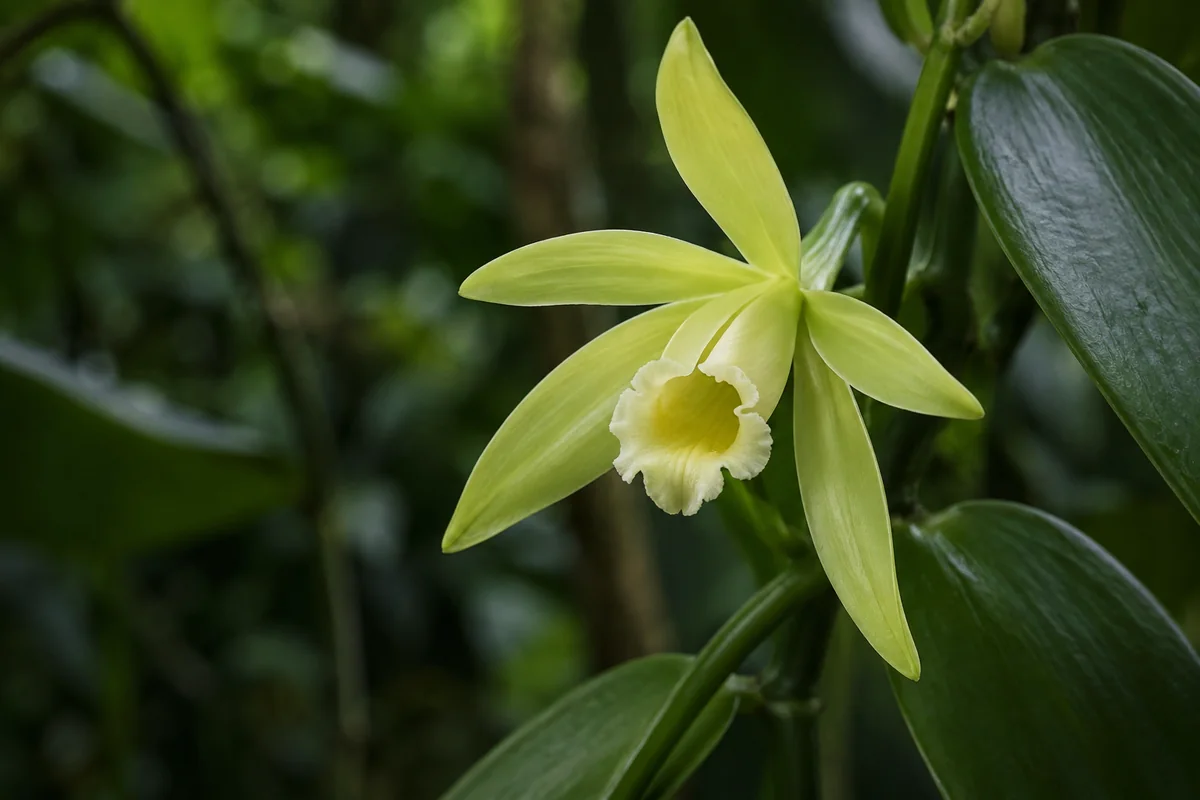
The flower opens for a day; after pollination, the fruit develops.
The vanilla orchid climbs a support using its aerial roots. It favours humidity and filtered light. In Madagascar, its flowers are pollinated by hand. About nine months pass between this step and fruit maturity. [9][13]
Vanilla’s ‘marriage’
During the flower’s short opening, hand pollination involves lifting the membrane separating the pollen from the stigma, then bringing them into contact. [24]
Find vanilla in the north-east.
Production is centred in the humid north-east. SAVA is a major vanilla-growing region in Madagascar. Maturity at harvest, sorting and conditioning then shape the pods’ aromatic profile. [8][19]
1SAVA
Sambava, Antalaha, Vohémar, Andapa. Madagascar’s main vanilla-growing region. These four names form the acronym SAVA. The coast and valleys support crops suited to heat, humidity and shade. [8][6]
2Maroantsetra and the eastern north-east
Around Maroantsetra, south of SAVA. Another documented growing region, extending along the humid eastern side. Vanilla’s geography therefore extends beyond SAVA’s administrative boundaries alone. [8]
Time and careful handling
develop the aroma.
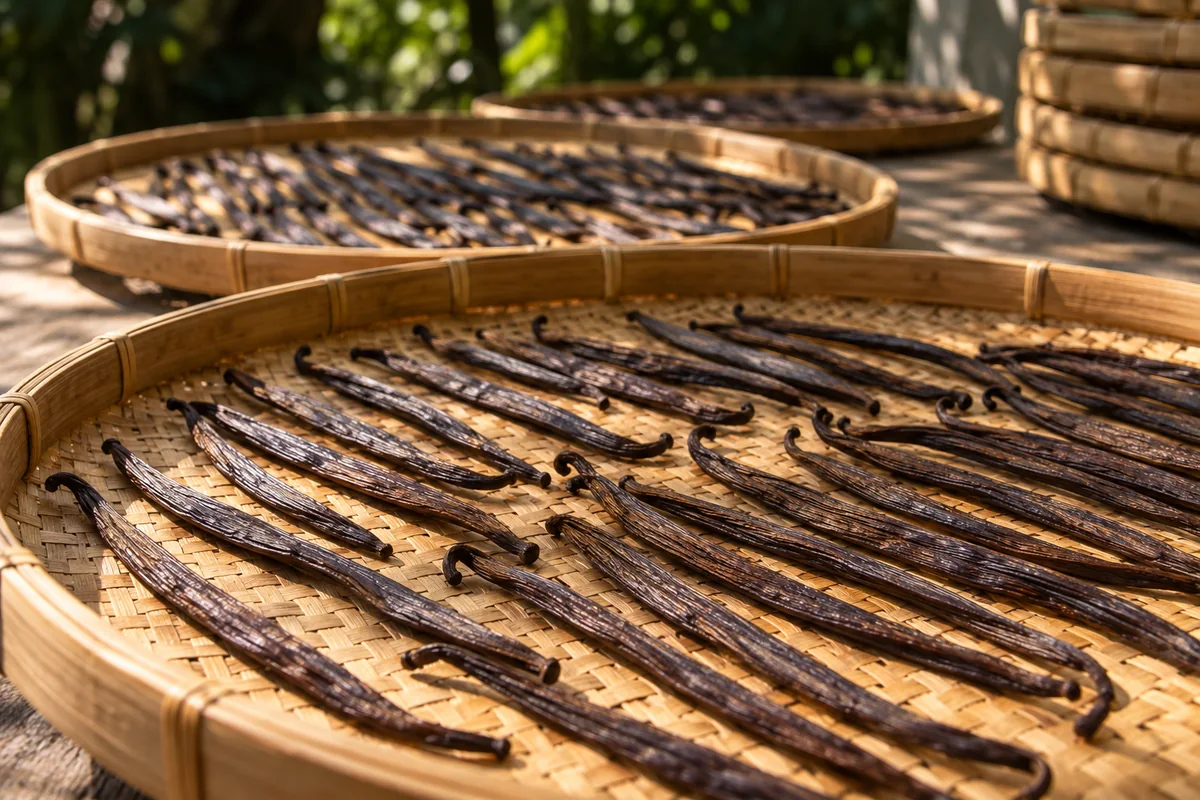
The green pod becomes cured vanilla
The aroma does not come from drying alone. In the green fruit, vanillin is bound as glucovanillin. Curing triggers enzymatic changes that develop the aroma. Ripeness, temperatures, drying and duration all influence the result. [14][19]
Harvest, heat, dry, rest: each stage develops the aroma.
Harvest when ripe
The pods are monitored individually and harvested when suitably ripe. Harvesting too early limits their aromatic potential. Schedules vary by area and growing season. [9][19]
Scald
In the usual Bourbon-style curing process, a brief immersion in hot water stops the fruit’s development. The precise parameters depend on the processor’s protocol and the condition of the pods. [16][15]
Sweat
The pods are kept warm in a humid environment. They turn brown and internal changes continue. [16][14]
Dry gradually
Alternating sun and shade reduces the water content of the fruit. The aim is even drying suited to the final product, without rushing the process. [16][15]
Condition, then sort
Resting in boxes allows the aromatic profile to develop and stabilise. Sorting, sizing and packing follow. The whole process takes several months, with the duration varying according to the methods used. [18][15]
Different vanillas,
different characters to discover.
Species, origin, variety: three distinct details on the label.
The most familiar in Madagascar
Vanilla planifolia
This orchid from the Americas accounts for the vast majority of vanilla traded worldwide. In Madagascar, it supplies most of the vanilla known for its characteristic vanilla profile. Its aroma combines many compounds; vanillin is a major molecule, but does not represent the entire bouquet on its own. [3][20]
Vanilla × tahitensis
This hybrid gives more prominence to anise notes. Its name does not tell you where it was harvested.
Discover this vanilla orchid
Vanilla pompona
A less common species, distinct from planifolia grades.
Varieties, selections and native vanilla orchids
A single species can include several varieties or selections. To improve the resilience of Vanilla planifolia, Cirad is studying its genetic diversity. The terms “Gourmet”, “red” and “frosted” do not name these varieties. [3][22]
Madagascar is also home to native vanilla orchids: Kew lists Vanilla madagascariensis, among others, as a species whose natural range is limited to Madagascar. It is distinct from Vanilla planifolia, the main species grown for commercially traded pods. [25][2]
Choose a beautiful pod,
then cook with it.
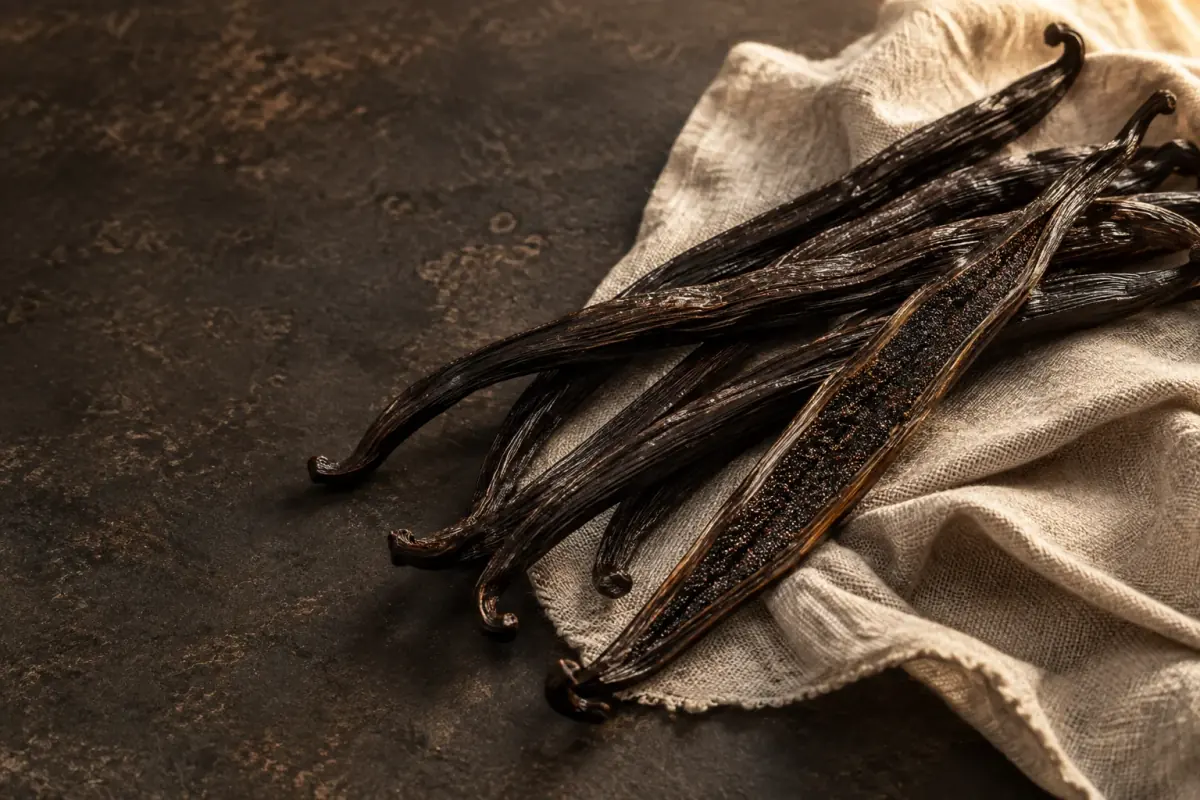
Split a dark, supple, fragrant pod and scrape out its seeds and pulp. Discover the forms suited to other uses.
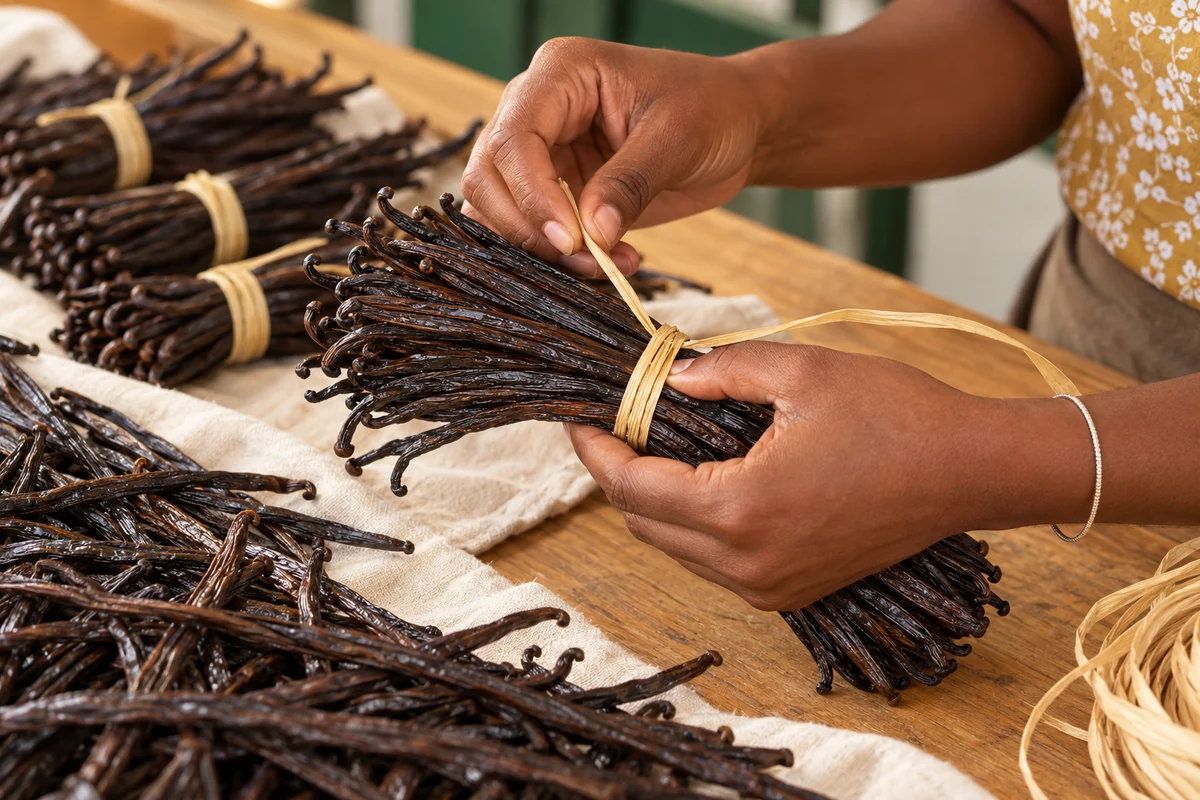
Black / Gourmet
Supple and dark, it is suited to splitting open and scraping out the pulp.
A dark, supple and relatively moist pod, sought after for direct use in cooking and easy scraping of the pulp. Appearance matters a great deal. [16][17]
TK
Still supple, often drier: a trade designation whose characteristics should be checked with the supplier.
A trade term commonly associated with a pod that is drier than some gourmet selections, but still supple. The exact definition depends on the supplier and specification. [17]
Red / extraction
Drier, often chosen for extracts. Its appearance reflects a use, without telling the whole story of its aroma.
Drier vanilla with reddish-brown tones, often intended for extracts. Lower moisture may suit this use; it does not automatically mean a lack of aroma. [17]
Split
The pod has opened. Its appearance changes; its aromatic value is assessed by considering the batch as a whole.
A pod can split lengthways when ripe. This affects its appearance and grading, but is not enough to judge its full aromatic potential. Check the general condition of the batch. [9][18]
Frosted
Vanillin can crystallise on the surface. However, a white deposit needs to be identified rather than judged at first glance.
Vanillin can crystallise naturally on the surface during aromatic maturation. This phenomenon does not define a variety. A white deposit is not necessarily made of vanillin. [4][21]
Grades, moisture and standards: the details
Trade designations combine appearance, moisture, dimensions and intended use. Their use varies between suppliers. Product standards also exist, including Codex CXS 367-2026 for vanilla: these should not be confused with the terms gourmet, TK or red alone. Comparing two batches requires knowing their actual characteristics and intended use. [23]
The terms “Bourbon” and “Premium” describe the designation and selection. [17] The PRULAB report for the analysed sample adds moisture and vanillin measurements to these details.
Moisture & vanillin:
understanding the figures.
Moisture tells you about texture; vanillin, about part of the aroma. Compare their percentages on the same basis.
Moisture expressed as a percentage of product mass
Water contributes to the pod’s suppleness.
- Grade A / Gourmet
- 25–35 %
- Extraction grade
- ≈ 20 %
These guidelines from the University of Florida describe commercial uses. A moister pod is generally more supple; more water does not mean more vanillin. Specifications may vary. [16]
Vanillin content: which reference should you use?
The same basis,
for a useful comparison.
For example, a content of 2% on an as-is basis is in the upper half of the commonly observed range of 1.6 to 2.4%, cited in ISO 5565-1 for planifolia. To compare reports, use the same measurement basis and take moisture into account. Aroma, suppleness and the curing of the pods complete the picture. [28]
At 30% moisture, 2% in the product = 2.86% on a dry-matter basis. Conversely, 2% on a dry-matter basis represents only 1.40% in the product at the same moisture level.
Estimate your vanilla’s profile ↓Understand the vanilla you have chosen
Grade my vanilla
Describe your cured planifolia vanilla, then enter its moisture and vanillin content: the tool provides an indicative estimate.
View the criteria and how the estimate works
The table is adapted from Codex CXS 367-2026 for V. planifolia. It compares vanillin on an as-is basis and first converts any value entered on a dry-matter basis. [23]
| Form / class | Moisture | Minimum vanillin in the product |
|---|---|---|
| Whole · Extra | 35–38 % | 1,8 % |
| Whole · I | 30–36 % | 1,6 % |
| Whole · II | 25–30 % | 1,4 % |
| Whole · III | 15–25 % | 1,2 % |
| Split | 15–25 % | 1,2 % |
| Cut / pieces | 10–25 % | 1,0 % |
When a value lies on a shared boundary, the tool selects the highest class for which both criteria are met. A concerning description or inconsistent texture suspends a favourable result. This consistency check is part of the tool; the Codex does not define it as a physical threshold. The trade designations “Gourmet”, “TK” and “red” follow other conventions.
Above 2.4% in the product, check the reporting basis and the analysis report: this is the point requiring attention in ISO 5565-1. This content does not automatically improve the grade. [28]
Use this tool for cured pods of planifolia intended for food use. Other species, extracts, powders and products for industrial processing need their own criteria.
Understand and try the dry-matter calculation
Follow the calculation step by step
Understand the content
“on a dry-matter basis”.
Take 30% moisture: in 100 g of pods, there are 30 g of water and 70 g of dry matter. The example’s 2 g of vanillin are included in those 70 g.
Vanillin on a dry-matter basis (%)= product content × 100 ÷ (100 − moisture)
Enter both values as percentages of the as-is product. The calculation removes water from the denominator while keeping the same amount of vanillin.
To return to the product content: dry-matter content × (100 − moisture) ÷ 100. For example, 3% on a dry-matter basis with 30% moisture gives 2.10% in the product.
Why vanillin content does not tell the whole aroma story
A study published in 2009, covering 30 samples from two species and seven countries, found 1.7 to 3.6% vanillin on a dry-matter basis in the Vanilla planifolia samples. This range describes the study; it does not define a trade grade. [27]
When the basis stays the same, a higher percentage means more vanillin in the same mass. To understand the pod’s full bouquet, its other compounds must also be taken into account.
What to look for in an analysis report
A useful report identifies the sample, date, moisture, vanillin content, units and reporting basis. ISO 5565-2 describes, among other methods, determination by high-performance liquid chromatography (HPLC) and a method using ultraviolet spectrometry. [26]
Compare on the same basis, using the measured moisture of the same sample. Then return to the batch: its aroma, curing and condition complete the interpretation of the figure. Vanillin is not the only molecule in its bouquet. [20]
Ask for the percentage’s reporting basis and the moisture measured alongside it.
Your pod is chosen,
let’s head to the kitchen.
Infuse cream or flavour a batter: choose the form of vanilla to suit your recipe.
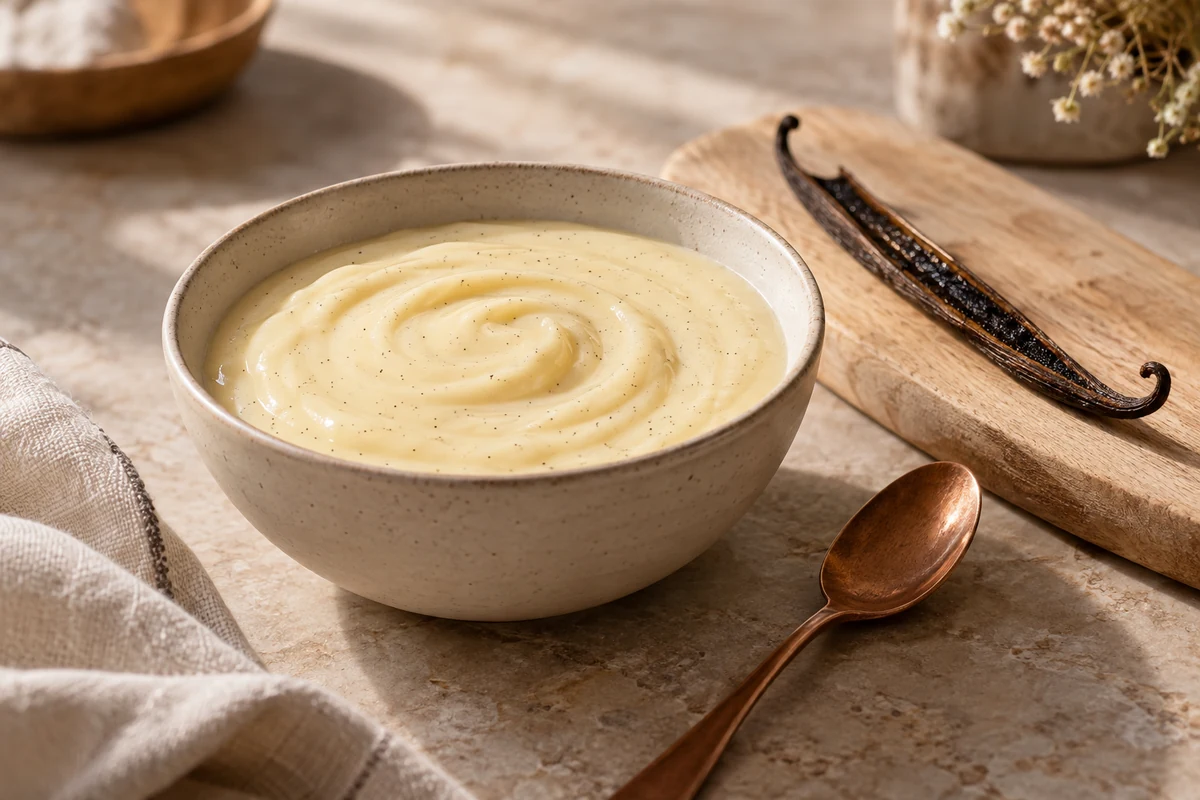
Whole pod
For cream, milk, ice cream or a sauce, split the pod and infuse both pulp and pod together. The aroma is not limited to the little black seeds. Infusion time and the composition of the preparation change how the aroma is perceived. [1][20]
Powder
Powder disperses through a batter or dry mixture. Check the ingredients and proportion of vanilla: vanilla powder, vanilla sugar and flavoured products have different compositions. [10][19]
Extract
Extraction transfers aromatic compounds from the pods into a liquid, often a mixture of water and alcohol. Concentration and ingredients vary between products; compare doses using their usage instructions. [18]
Vanillin
Vanillin is a molecule. A pod also contains other compounds that contribute to its aroma. A preparation flavoured only with vanillin therefore does not offer exactly the same aromatic combination as a pod or its extract. [20][21]
Paste & “caviar”
Check the proportion of vanilla, sugar and other ingredients before deciding on a dose.
Vanilla sugar
Vanilla sugar adds flavour and sweetness: read its ingredients and adjust the sugar in the recipe.
Keep your vanilla
for your next inspiration.
Behind a pod, the work of a whole sector
Vanilla requires extensive manual work. Diseases, particularly Fusarium wilt, and climate variations make production more difficult. Current research focuses in particular on genetic diversity and more resilient plants. Final quality therefore connects the plant, work in the field and the processor’s work. [22][3]
Vanilla to split,
cook with and keep.
Keep the printable practical guide to split, store and reuse your pods after the trip.
Pod or powder? Compare the forms and ingredients, then prepare a sauce for fish.
Another question about your vanilla?
Is a longer pod always better?
Length tells you about the pod’s presentation. For cooking, also look at its ripeness at harvest, aroma, curing and the condition of the batch. [19]
Is red vanilla a different species?
The commercial form called “red” is drier and commonly used for extraction. It is not a different species of vanilla. [17]
Do the black seeds contain all the aroma?
For an infusion, keep the split pod and its pulp together: the pod’s skin also contributes to the aroma. Remove it before serving. [20]
Is a white deposit always vanillin “frost”?
Vanillin can form crystals, but the mere presence of a white deposit does not identify it. If the appearance or smell seems suspicious, ask the supplier for advice before using the pod. [4]
Explore further 28 historical & botanical references
Feature checked on 22 September 2026. The numbers throughout the text refer to the sources below. The regions described locate growing areas; each batch’s origin is checked separately.
- Royal Botanic Gardens, Kew · Vanilla, Vanilla planifolia
- Kew · From pods to puddings: Vanilla and other sweet-tasting orchids
- Cirad, 2022 · 83% of the vanilla orchid’s genetic heritage decoded
- INAO · Single document, Vanilla from Réunion Island
- G. Bouriquet, 1946 · The vanilla orchid and vanilla in Madagascar
- Éric Jennings, Histoire Politique 56, 2025 · The politics of vanilla in Madagascar, 1960–1985
- Cirad, 2024 · Fifth International Vanilla Congress
- Andriatsitohaina et al., 2024 · Agroforestry in Madagascar: past, present, and future
- INRAE / Cirad, 2022 · Tropifruit: growing vanilla
- ISO · Vanilla, specification, note on geographical designations
- Établissement Vanille de Tahiti · A natural and unique product
- Kew, Plants of the World Online · Vanilla pompona Schiede
- University of Florida, IFAS · Vanilla, Gardening Solutions
- Van Dyk et al., Fruits 65, 2010 · Influence of pod curing methods on sensory quality
- FAO · Case Study of the Papua New Guinea Vanilla Industry, vanilla curing
- University of Florida, IFAS, 2025 · Flower pollination and vanillin extraction
- CBI, Netherlands Ministry of Foreign Affairs · Entering the European market for vanilla
- University of Florida, IFAS · Natural Vanilla Extract Production
- FAO, 2009 · Vanilla: Post-harvest Operations
- Hervé This, INRA · Vanilla cream, molecular gastronomy workshops
- FAO / JECFA · Vanillin, flavouring substance specifications
- Cirad · Research in Toamasina on the vanilla orchid’s climate and disease challenges
- FAO / WHO, Codex Alimentarius · CXS 367-2026, Requirements for vanilla
- University of Florida, IFAS · Vanilla Growing in South Florida
- Kew, Plants of the World Online · Vanilla madagascariensis Rolfe
- ISO 5565-2:1999 · Vanilla test methods: moisture, HPLC and UV spectrometry
- Brunschwig et al., 2009 · Evaluation of Chemical Variability of Cured Vanilla Beans
- ISO 5565-1:1999, §7.2 · Specifications: commonly observed vanillin content
About the visuals & map
The editorial compositions were created with AI assistance. Retained photographs are credited below; their locations are given where documented.
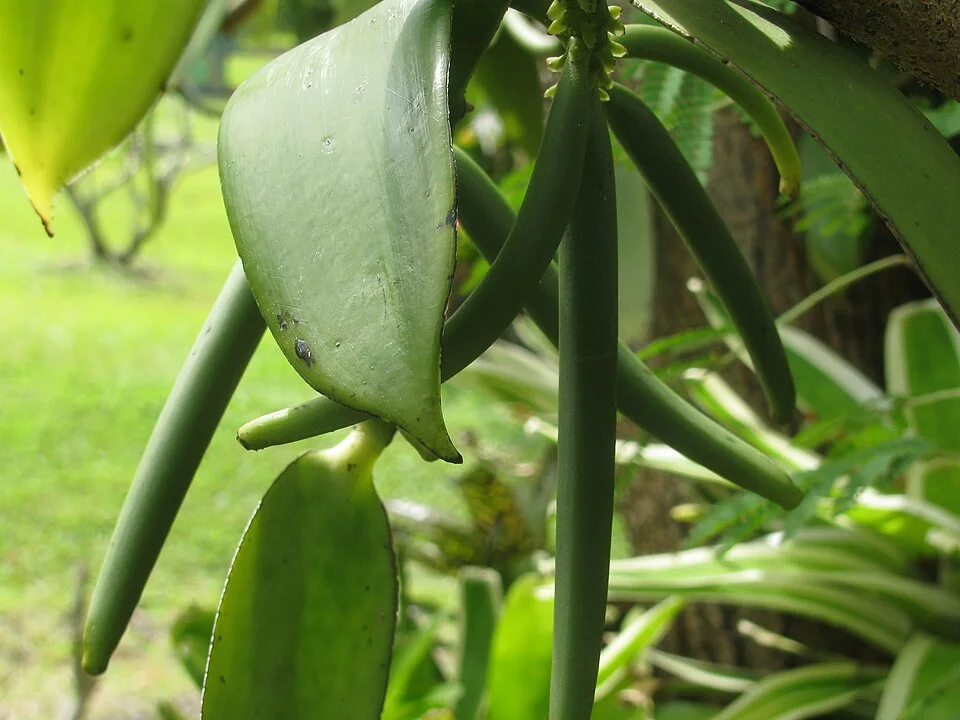
- Green vanilla fruits in Maui. · Forest & Kim Starr · CC BY 3.0 US. WebP format and display crop.
Base map: Natural Earth, public domain. The markers locate the places mentioned and do not represent cultivated areas.